How Much Does It Cost to Build a Single Storey House in Melbourne?

Building a single storey home in Melbourne in 2026 generally costs somewhere between $1,800 and $3,600 per square metre, depending on whether you go with a volume builder or a custom design. For a typical 180m² to 240m² family home, that usually works out to roughly $320,000 to $580,000 for construction alone. Land, site works, driveways, landscaping and fencing sit outside that figure and can add a meaningful amount on top, so it pays to budget for the whole picture rather than the build price alone.
If you are planning a new build and trying to work out where your budget needs to sit, this guide covers it properly. We look at the current cost to build a single storey house in Melbourne, including realistic per square metre rates for 2026, what three, four and five bedroom homes tend to cost, the site and finishing expenses most quotes leave out, why Victorian blocks make such a difference, and a few practical ways to keep your spend under control. The figures below are drawn from current industry benchmarks and government sources, referenced as we go.
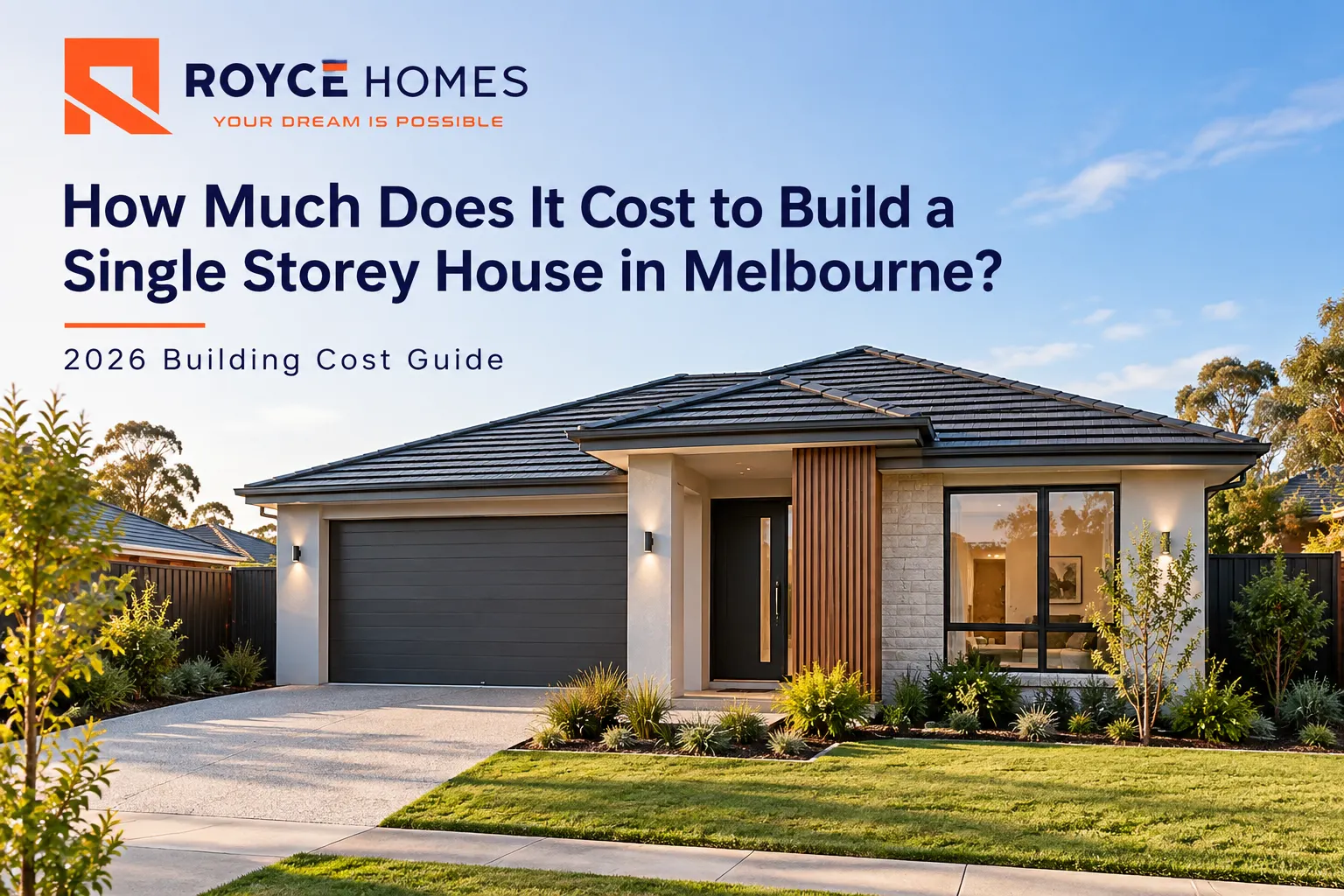
Modern single storey house in Melbourne with landscaped front yard, featured in a 2026 home building cost guide by Royce Homes.

What a Single Storey Build Costs Right Now

Most Melbourne builders quote on a dollars per square metre basis. Industry data from InfinityBuilt puts volume builder rates in Melbourne’s outer growth corridors at around $1,800 to $2,400 per square metre, while custom single storey builds typically land between $2,600 and $3,600 per square metre. Carlisle Homes reports a broadly similar range for single storey project homes. Anything highly architectural or heavily customised can move beyond that. 

Single storey is usually cheaper per square metre than double storey, mainly because there is no staircase, no scaffolding and less structural steel involved. Industry estimates suggest a second storey can add several hundred dollars per square metre, though the actual gap depends heavily on the specific design. 

Here is roughly where things land for the build portion only:

Home size

Typical floor area

Build cost (2026)

3 bedroom

150m² to 180m²

$260,000 to $400,000

4 bedroom

180m² to 240m²

$400,000 to $600,000

5 bedroom

240m² to 300m²

$480,000 to $750,000+

These are indicative bands rather than fixed prices. A four bedroom single storey home on a flat block in one of Melbourne’s growth corridors remains one of the most common builds going through councils, and $320,000 to $580,000 is a reasonable planning range for it, though your actual figure will depend on your builder, design and inclusions. 

What Actually Moves the Number

Two families can build a similar floor plan and still end up a long way apart in price. A few factors tend to do most of the work. 

Your block. Much of Melbourne sits on reactive clay soils, and a Class H or E soil classification can add several thousand dollars in extra footings before construction even starts. Sloping blocks may also need retaining walls and extra excavation, which can push site costs from around $10,000 on an easy, flat block to $45,000 or more on a genuinely difficult one. These figures vary block by block, so a soil test is the only way to know where you sit. 

Design complexity. A simple, rectangular footprint with a straightforward roofline tends to be the most cost-effective option. Every extra corner, void or large expanse of glazing adds cost. Choosing from a builder’s proven range of single storey home designs is often a more economical route than a fully custom plan, since those layouts have already been refined and built many times over. 

Finishes and selections. Standard laminate benchtops and basic joinery sit at the lower end. Stone benchtops, custom cabinetry and upgraded flooring lift the rate. Many buyers end up spending somewhere in the order of tens of thousands of dollars on upgrades during colour selection, so it is worth setting that expectation early. 

Energy compliance. Victoria has required new homes to meet a 7-star thermal performance standard plus Whole of Home energy requirements since 1 May 2024, under changes to the National Construction Code. There is genuine debate about what this adds to build cost. Industry body estimates have ranged from around $4,300 on average nationally up to $20,000 in some Victorian modelling, while government analysis argues the upfront cost is often modest and can be offset by long-term energy savings. In practice, the real cost depends heavily on your specific design and orientation, so it is worth asking your builder for a figure specific to your plans. 

The Costs That Sit Outside the Contract

This is where budgets get into trouble. A contract price is not a move in price. Plan for these separately:

  • Landscaping, driveways, fencing and letterbox: $40,000 to $80,000
  • Blinds, floor coverings and window furnishings if not included
  • Council and building permits, plus service connections
  • Site costs above the provisional sum: commonly $10,000 to $30,000 over

Because of this, a house advertised at $550,000 can realistically end up closer to $650,000 to $720,000 once landscaping and finishing touches are accounted for. As a general guide, allowing an extra 15 to 20 per cent above the contract price is a sensible way to estimate your true all-in figure, though this will vary by project. 

Where the Market Is Heading in 2026

Forecasters differ slightly on the pace of change, but the direction is consistent. Rider Levett Bucknall’s Q4 2025 market update forecasts Melbourne construction costs to rise by around 4 per cent through 2026, while the AIQS Building Cost Index has tracked closer to 3.5 per cent over the year to January 2026, making Victoria one of the more moderate markets nationally. Either way, costs are still trending upward, driven largely by skilled labour shortages and a busy construction pipeline.

At the same time, new residential lots in Melbourne have been shrinking, which is changing what people build. On a narrower block, a well planned single storey design can often deliver better liveability and value than a cramped double storey home.

The practical takeaway is that locking in a fixed price contract sooner rather than later can help protect you from further escalation, and a fixed site cost offer is worth asking about if your builder provides one.

Government Support Worth Knowing About

First home buyers building a new home in Victoria may be eligible for the First Home Owner Grant of $10,000 for properties valued at $750,000 or under, administered by the State Revenue Office Victoria. Eligible first home buyers may also pay no stamp duty on properties valued up to $600,000, with a reduced rate applying between $600,001 and $750,000. These are general eligibility settings and rules can change, so it’s worth confirming your own circumstances directly with the State Revenue Office before you budget around them.

Keeping Your Budget Under Control

Get a soil test before you sign anything. Ask every builder exactly what their headline rate includes, since a cheaper quote often just means more has been excluded. Keep your floor plan efficient rather than sprawling where you can. And build in a contingency of around 10 to 15 per cent, since most projects use at least some of it along the way. 

Final Thoughts

The cost to build a single storey house in Melbourne is genuinely manageable once you move past averages and look at your own block, your own plan and your own selections. Many families land somewhere between $320,000 and $580,000 for the build itself, with additional budget needed for the site works and finishing touches that make a house feel complete. 

If you would like a clearer, more personalised figure for your block and preferred design, the team is happy to walk you through it with no pressure. Get in touch through the contact us page and we will talk you through a realistic breakdown rather than a generic headline number.

Frequently Asked Questions

1. Is it cheaper to build a single storey or double storey in Melbourne?
Single storey is generally cheaper per square metre. You avoid the cost of a staircase, scaffolding, extra structural steel and trades working at height, which can add up to $1,000 per square metre on a double storey build. Double storey does become competitive on small blocks, because you need less land to get the same floor area. On a standard flat lot with room to spread out, a single storey almost always delivers better value per square metre.
2. How long does a single storey home take to build in Melbourne?
Most single storey project homes take around six to ten months from slab pour to handover, assuming reasonable weather and no major trade delays. Before construction starts, allow another three to six months for design, engineering, soil testing, council approvals and building permits. Custom homes take longer, often ten to eighteen months on site. Realistically, from signing your contract to moving in, plan for twelve to eighteen months for a straightforward single storey build.
3. What is included in a builder's base price?
A base price usually covers the structural build, standard inclusions, builder’s margin and GST. It typically excludes land, landscaping, driveways, fencing, blinds, floor coverings in some cases, and anything above the provisional site cost allowance. Permits and service connections may or may not be included. Always ask for a written inclusions list and compare it line by line between builders, because a lower base price often just means more items have been shifted outside the contract.
4. How much are site costs in Melbourne?
Site costs range from about $10,000 on a flat, fully serviced block to $45,000 or more on a sloping or difficult site. They cover soil testing, site clearing, excavation, retaining walls, temporary fencing and utility connections. Melbourne’s reactive clay soils are the main variable. A Class H or E classification can add $5,000 to $20,000 in engineered footings alone. A soil test before contract signing is the only way to avoid surprises here.
5. Does a bigger block mean a more expensive build?
Not directly. Your build cost is driven by floor area, design complexity and finishes rather than land size. A bigger block can actually reduce some costs by giving trades easier access and more room for machinery. However, larger blocks usually mean more landscaping, longer driveways and more fencing, which are separate expenses. Sloping or heavily treed land also raises site costs regardless of size, so the terrain matters far more than the acreage.
6. Can I build a single storey house in Melbourne for under $300,000?
Yes, but you need to be realistic about size and finishes. A compact three bedroom project home of around 150 to 170 square metres on a flat, easy block can come in under $300,000 for construction with standard inclusions. That figure excludes land, landscaping, driveway and fencing. Once you add upgrades, a larger floor plan or a difficult site, most buyers find their final number moves above that mark fairly quickly.
7. Are building costs in Melbourne going up in 2026?
Yes. Construction costs across Victoria are forecast to rise roughly 4 per cent through 2026, driven by skilled trade shortages and a strong pipeline of residential and infrastructure work. Material prices have stabilised compared with the sharp increases of recent years, but labour remains the pressure point. If you are close to ready, signing a fixed price contract sooner helps protect your budget from escalation over a long build period.
8. What government help is available for first home buyers in Victoria?
First home buyers building a new home in Victoria may be eligible for the First Home Owner Grant of $10,000, along with stamp duty concessions or exemptions depending on the property value. Because you pay duty on the land value rather than the completed house, building new often costs less in duty than buying established. Eligibility rules change, so check current details with the State Revenue Office Victoria before budgeting.
9. How much contingency should I budget for?
Set aside 10 to 15 per cent of your contract price as a contingency. Variations happen on almost every build, whether through site cost overruns, upgrade decisions made during colour selection, or changes you request once you see the frame go up. Having that buffer means a $15,000 surprise is an inconvenience rather than a crisis. If you do not use it, you have a head start on landscaping and furnishings.
10. Is a fixed price contract worth it?
For most buyers, yes. A fixed price contract locks in your build cost and protects you from material and labour increases during construction, which matters on a build running twelve months or more. Read it carefully though. Provisional sums and prime cost items can still move, so check how site costs are treated. A builder offering fixed site costs after a soil test gives you far more certainty than a headline price alone.