
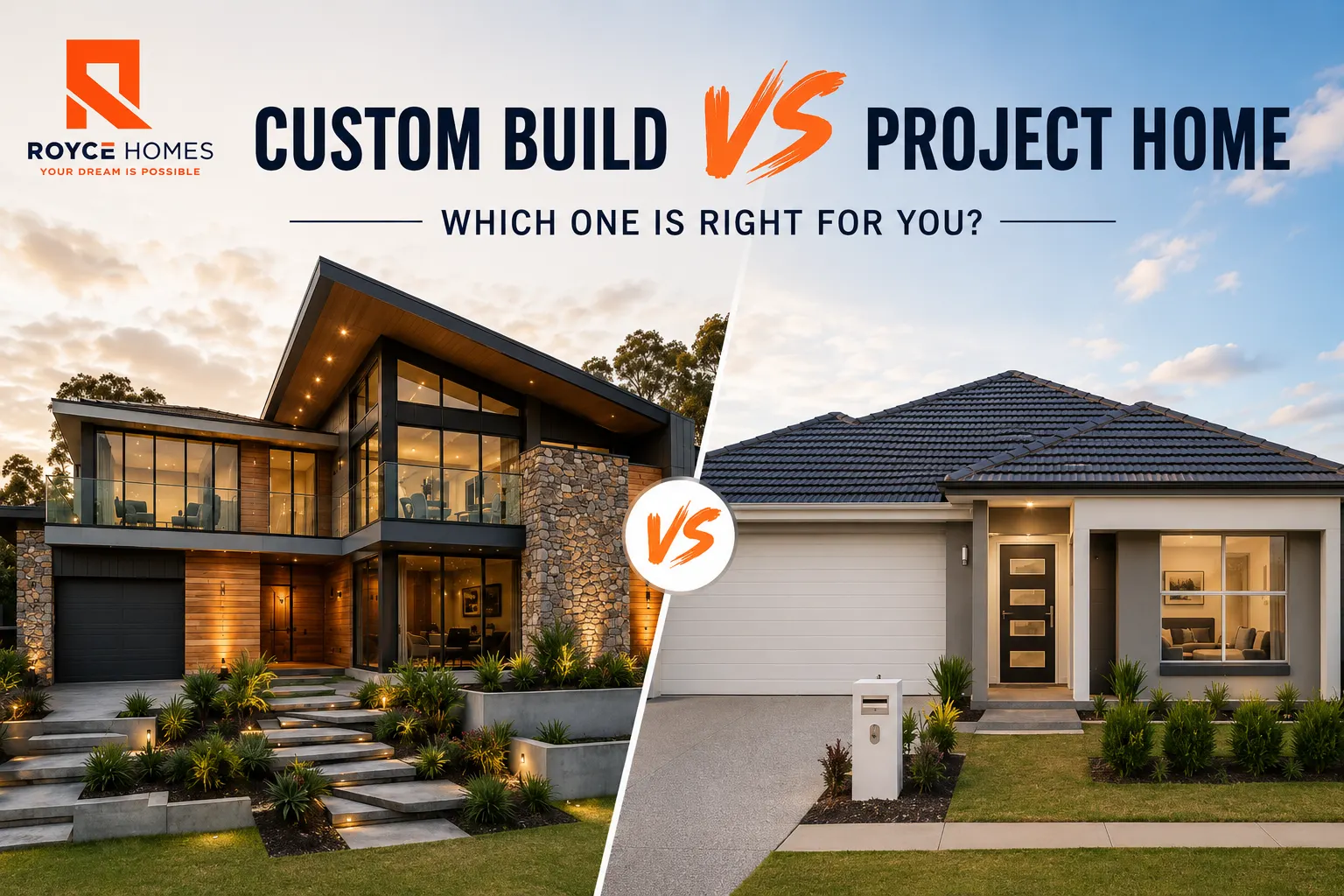
Custom build vs project home, which should you choose? Go with a project home if you want a faster build, a lower upfront cost, and your block is flat and standard. Go with a custom build if your block is sloped, narrow, or irregular, or if you want full control over the layout and design rather than picking from a fixed floor plan. Project homes typically cost less and move faster because the design has already been built many times before. Custom builds cost more and take longer, but the home is designed specifically around your block, lifestyle, and long-term needs.
If you’re at the stage of choosing a builder, you’ve probably already hit this fork in the road. Do you go with a display-home design that’s been built a hundred times before, or do you start from scratch and build something that’s genuinely yours? Working out the Custom Build vs Project Home question is one of the first big decisions in the whole process, and it’s worth getting right, because it shapes everything else that comes after it.
Both paths get you to a finished home. But they get you there very differently, and they suit different people, different blocks, and different budgets. Let’s go through it properly.
A project home is a design the builder has already built, probably dozens of times, sometimes hundreds. You walk through a display home, you like the layout, you pick a facade and a finished package from whatever’s on offer, and that’s more or less your house. The builder isn’t starting from zero. They know exactly how long each stage takes and roughly what it’ll cost before they’ve even met you, because they’ve done this build so many times the numbers are basically locked in.
That familiarity is the whole selling point. It’s cheaper, it’s faster, and there’s a lot less that can go sideways.
A custom build starts somewhere else entirely. There’s no display home to walk through because the house doesn’t exist yet, not even on paper. You sit down with your builder, talk through how you actually live, your block, your family, whatever quirks matter to you, and the design comes out of that conversation. Nothing’s decided before you’ve had input.
It takes longer. It costs more, usually. But what you get at the end is a home built around your life, not one you’re expected to adjust your life around. If you want a sense of what that actually looks like in practice, it’s worth a browse through Royce Homes, where you can see the range of custom designs on offer before you even sit down for a first conversation.
Project homes tend to be cheaper, and there’s a straightforward reason for it. The builder’s already worked out every kink in the design, materials get bought in bulk, and the trades move fast because they’ve done this exact job before. None of that applies to a custom build. Every decision is being made for the first time, which means more time, and more cost.
That said, there’s a catch worth knowing about. If your block isn’t flat and standard, if it slopes, or it’s narrow, or it’s an odd shape, a project home’s floor plan might not actually fit without a lot of extra site work. And that site work isn’t cheap. So on paper the project home looks like the budget option, but once you add in what it costs to force a standard design onto a non-standard block, the gap between the two can shrink fast, sometimes to nothing.
With a project home, you’re picking from a menu. This facade, that bench top, maybe an optional alfresco if it’s on the list. It’s flexible, but only within a shape that’s already fixed.
Custom is a different conversation altogether. The floor plan itself is up for grabs. Want the kitchen facing north instead of the living room? Want a study instead of a fourth bedroom nobody will use? That’s the sort of thing you can actually change, because nothing’s locked in until you say it is.
If you’ve got a genuinely specific way you want to live, and a standard layout just doesn’t fit that, this is where a custom build starts to make a lot more sense.
Project homes move quickly. There’s very little guesswork for the builder, so things tend to run on schedule. Custom builds take longer, and that’s true at almost every stage. Design takes longer because it’s being drawn from scratch. Council approval can take longer if the design isn’t a standard, pre-approved shape. Even construction itself often runs a bit slower, because trades are working through something new rather than repeating a job they could do half asleep.
If getting into your home quickly matters more to you than getting every detail exactly right, that’s a real point in the project home’s favour.
More than people expect, honestly. A project home is designed for what builders call a “typical” block: flat, rectangular, a standard-width frontage. Put that same design on a sloping block or a narrow lot and you’ll either spend a lot fixing the mismatch, or you’ll end up with a home that technically works but doesn’t really make the most of the land you’ve got.
A custom build starts with the block itself. The design responds to the slope, the orientation, the shape, whatever’s actually there. It’s usually the smarter option for anything other than a straightforward, standard block, not because custom is inherently better, but because it’s built to fit what you’ve actually got instead of what a generic plan assumes you’ve got.
Project homes tend to look a lot like the houses around them, which isn’t a downside exactly. Familiar layouts are easy for future buyers to understand, and that has its own kind of value. Custom homes, done properly, tend to hold up over time because they’re designed for the block and for how the owners actually live, not for a generic buyer who might come along later.
If you’re planning to stay for the long haul, a custom build’s ability to actually suit your changing needs, more space as the family grows, a home office you didn’t think you’d need, ageing in place down the track, tends to pay off more over the years than a fixed layout ever will.
Here’s where people trip up. Some buyers choose the project home purely because it’s cheaper, without checking whether the design actually suits their block, and end up paying for site works that quietly wipe out whatever they thought they were saving. Others go custom without settling a firm budget upfront, and the design keeps growing every time they sit down with the builder, until the number’s a lot bigger than what they started with.
Neither mistake ruins a build. But both are easy to avoid if you go in clear-eyed about your block, your budget, and what you actually need the home to do for you.
There’s no single formula for weighing up Custom Build vs Project Home that works for everyone. It genuinely comes down to your situation. But once you understand what each option is actually offering, and where each one tends to struggle, the decision usually gets a lot easier to make.
Every block is different, and every buyer wants something slightly different out of their home. That’s why the Royce Homes team starts with a conversation, about your land, your budget, and how you actually want to live, before recommending whether a custom design or a more straightforward build makes more sense for you. If you’re still weighing up Custom Build vs Project Home for your own block, get in touch with the Royce Homes team and let’s work out what’s actually right for you.
A custom build is designed from scratch around your lifestyle, budget, and block. A project home is a pre-designed layout the builder has already constructed many times, offering less flexibility but usually a lower cost and quicker build.
Usually, yes. But on a sloping, narrow, or oddly shaped block, a project home can end up needing costly site works to fit properly, which sometimes closes the price gap between the two almost entirely.
Project homes tend to move faster since the builder already knows the design inside out. Custom builds usually take longer across design, approvals, and construction, simply because more of it is being figured out for the first time.
To some extent. You can typically choose from a set list of facades, finishes, and add-ons, but the floor plan itself stays fixed. If you want to change the actual layout, custom is the better route.
Custom builds generally handle unusual blocks much better, since the design is built around the block’s actual conditions rather than assuming a flat, standard shape.
They can, but it’s worth confirming exactly which items are fixed and which are provisional before signing, since custom designs usually involve more bespoke choices than a standard project home contract.
Probably not. If your block’s standard and you don’t have strong opinions on layout, a project home is likely to give you better value for the money.
Not necessarily better or worse, just different. Custom homes built to suit the block and the owner’s long-term needs tend to hold their appeal well; project homes are easier for buyers to compare since they’re similar to the homes around them.
Yes, though the design is meant for a standard block. If your land is irregular or sloped, it may need modification, and a custom build is usually the safer bet in that case.
It comes down to your block, your budget, your timeline, and how particular you are about the details. Cost and speed tend to favour project homes; a specific vision, an unusual block, or long-term plans tend to favour custom.